From the Book — Chapter 11
The Digital
Activity Trap
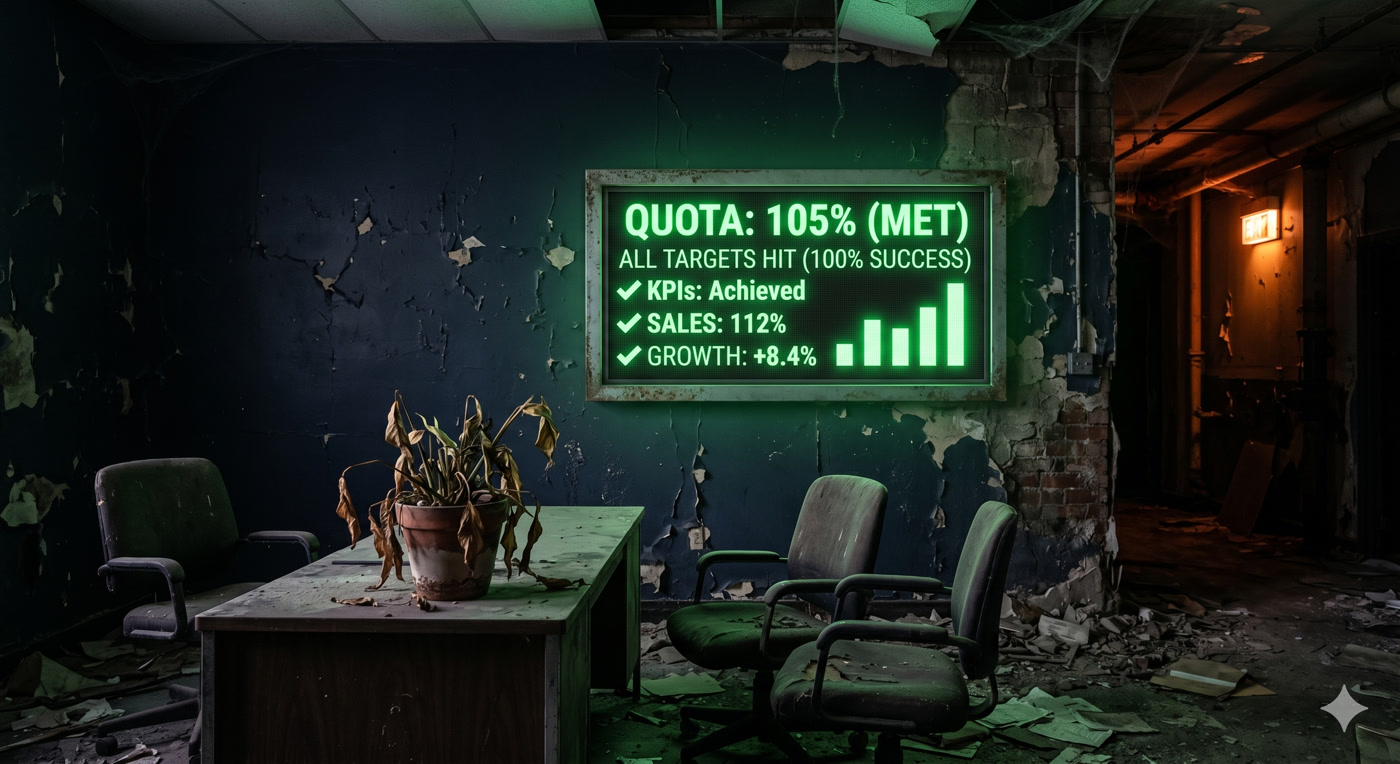
"The system looks efficient. The dashboards are green.
But the business is rotting from the inside."
You escaped chaos. You installed the CRM, built the quotas, turned on the dashboards. You moved from "I think" to "I know." Except you don't know. You're measuring motion — and calling it momentum.
Sound familiar?
Sales hit 105% of their call quota. Revenue is flat.
Support tickets are closing faster. Customers still feel unheard.
The CRM is full of data. None of it explains why you're losing deals.
Your best reps ignore the system. Your average reps are trapped in it.
Every metric is green on Monday. Every Friday feels like a loss.
You have more dashboards than ever and less clarity than ever.
You didn't build a bad system. You built a system that measures the wrong things — perfectly.
How You Got Here
It felt like progress.
The Guesser's world is terrifying — chaos, unpredictability, a business held hostage by heroes whose methods no one can explain or replicate. You had no levers to pull. You couldn't diagnose problems, predict revenue, or scale. So you did what every rational leader does: you installed the tools.
The CRM. The productivity dashboards. The call quotas. The SLAs. The activity reports. For the first time you had metrics. You moved from the subjective world of "I think" to the comforting world of "I know." The siren song of modern management rang out:
"You can't manage what you don't measure."
It felt like victory. It looked like control. That's when the trap springs shut. Because at this stage of maturity, you don't yet know what creates a good outcome — so you build your measurement system around the only thing you can see: effort.
The Core Problem
You're measuring activity. Not outcomes.
The Digital Activity Trap occurs when a company builds its performance management system around inputs — calls made, tickets closed, fields filled — rather than the outcomes those inputs are supposed to produce. The result looks like accountability. It is a sophisticated form of blindness.
Your CRM tracks calls made — not why a customer bought
Your support software tracks ticket close time — not whether the problem was solved
Your warehouse system tracks scans per minute — not safety or quality
Your dashboards show activity metrics in green — while outcomes quietly rot
This creates a hidden crisis. You celebrate that average call handle time dropped 30 seconds while remaining completely blind to the fact that customer satisfaction is cratering because no one's problem is actually being solved. You're optimizing a proxy — and optimizing a proxy is the fastest way to kill the real thing.
"Optimizing a proxy is the fastest way to kill the real thing."
— AI-Powered Growth, Chapter 11
The AI Problem
AI doesn't fix a broken process. It accelerates one.
The Digital Activity Trap becomes dramatically more dangerous once AI enters the picture. When companies deploy AI tools on top of activity-based systems, they don't get smarter — they get faster at doing the wrong things. The AI sends more emails to more unqualified leads. It closes more tickets without solving more problems. It scales the proxy, not the outcome.
Without AI
A sales team makes 50 wrong calls a day. You have a process problem. The damage is bounded by human capacity. You'll feel it in 90 days.
With AI on a broken process
The same team, AI-assisted, makes 500 wrong calls a day. You've turbocharged the problem. The damage is unbounded and the dashboard still shows green.
This is why the order of operations matters. Before you automate, you have to know what you're automating — and whether it's worth automating at all. AI applied to the right process is leverage. AI applied to the wrong process is an accelerant on a fire.
In the Wild
This isn't theory. These are the autopsies.
The Digital Activity Trap has taken down some of the most well-resourced organizations on earth — not from lack of effort or investment, but from measuring the wrong things at scale. One preview from the book:
Banking
Wells Fargo — The "Great 8"
The metric: eight accounts per customer. Branch staff were monitored relentlessly, humiliated on daily calls, and threatened with termination for falling short. The system created a rational response to an irrational incentive — thousands of employees secretly opened millions of unauthorized accounts just to hit the number. The activity metric looked spectacular. The mission was being destroyed.
Result: $185M fine. Mass erosion of customer trust. Phony productivity — perfectly measured.
The book walks through three more autopsies — Whole Foods, Home Depot, and Amazon — each revealing a different dimension of the same trap.
Context
Where this trap lives on the staircase.
The Digital Activity Trap is the defining failure mode of Level 2 — The Manager. It's what happens when a company successfully escapes the chaos of Level 1 only to build a more sophisticated version of the same problem. The tools change. The fundamental error doesn't. In the Four Quadrants of Automation, it lives in Quadrant 3: Foolproof Systems — the first trap companies fall into when they try to scale through standardization.
The Persona
The Manager — Level 2
So busy measuring motion, they never notice they've lost all momentum. The Activity Trap in its natural habitat.
Read the full profile →The Quadrant
Foolproof Systems — Q3
The first automation trap. High standardization, low worker value. A fortress of efficiency that is, in fact, a prison.
See all four quadrants →The escape route is in the book.
How the trap forms, how to diagnose it in your own organization, and the exact shift that breaks it — covered in full in AI-Powered Growth, alongside the frameworks for building systems that measure what actually matters.
"You can't manage what you don't measure — unless what you're measuring is the wrong thing."